How to IMPROVE Your Running Form: Key Features
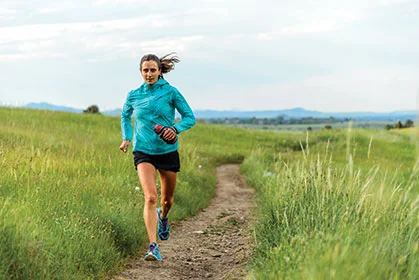
Calling all runners! What motivates you to go for an early morning run? How about an evening run after work? Perhaps you’re a weekend warrior?Common answers include: to improve fitness, reduce the risk of developing cardiovascular disease, to feel that “runners high”, to run your best time at the next marathon, you just love running outdoors, and/or to beat your friend on Strava.
Regardless of your reason, optimizing your running technique is key to achieving your goals! Not to mention, it can help to reduce the risk of common running related injuries, help to minimize muscle soreness post workout, and help you preserve your energy.
In this blog post, we are going to be looking at essential features in form to ensure you are running as efficient as possible. Additionally, we are going to identify exercises to help adjust your form, which in turn can help prevent running related injuries.
Key Feature: Midfoot Strike
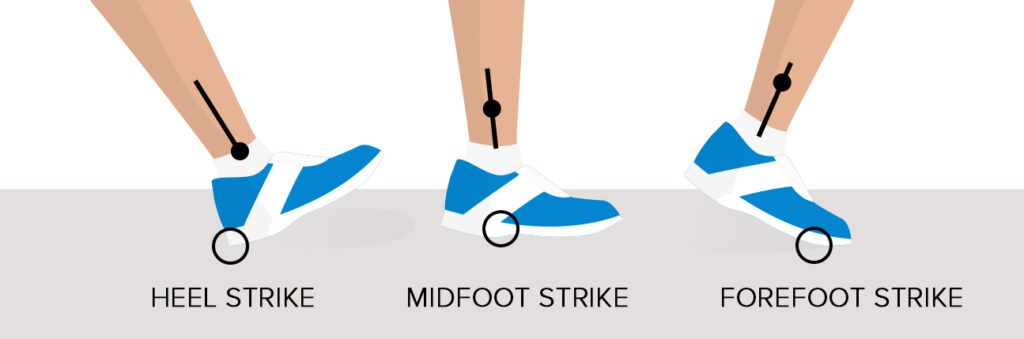
Which foot landing allows for an efficient stride; heel strike, midfoot strike, or forefoot strike? A heel strike slows down speed as it sends most of the force towards the shins, which can lead to stress fractures. Furthermore, a heel strike can be hard on the shin muscles and hamstrings, leading to overuse injuries.
A forefoot strike is recommended for sprinters as it provides a greater propulsion force, but this is not sustainable in long distance runners.
A midfoot strike is preferred over a heel strike and forefoot strike as it allows for a horizontal displacement of energy when the foot hits the ground. A midfoot strike allows the body to utilize the elastic energy stored in the tendons of the ankle, which preserves the energy required from the muscles.
Goals: In order to have a midfoot strike, the ankle joint must have enough strength and range of motion.
Exercise 1: A banded ankle mobilization can help increase ankle mobility.
Tip: Try to lean forward to bend the ankle as much as you can with the heel remaining flat on the floor!
Banded Ankle Mobilization Instructions HERE
Exercise 2: Banded ankle dorsiflexion can help increase ankle strength and stability.
Tip: Ensure the movement is coming from the ankle joint rather than the knee!
Banded Ankle Dorsiflexion Instructions HERE
Key Feature: Stride Length
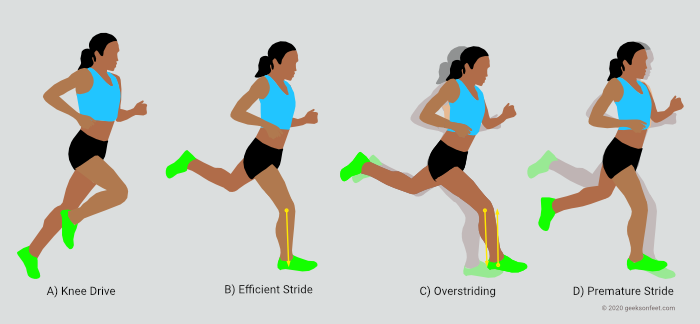
To maximize every stride, the knee drive must lead each step. It is important to lift the knees just below 90 degrees from the hip to generate enough energy when the foot hits the ground. Keeping the knees slightly flexed and in line with the toes can increase momentum and lessen the risk of knee injuries.
This technique should produce enough force in the foot so that the leg swings backwards without extra effort. The backswing utilizes the elastic energy stored in the hip flexors while minimizing the work of the hamstrings.
Goals: To generate more force in each step, the glute and quad muscles must be activated.
Exercise 1: Banded monster walks can activate the glutes to prevent knees caving in while running.
Tip: Pay attention to the leg that follows! Don’t let the band pull the leg towards you. Maintain control by slowly resisting the band and ensure the knees are in line with the ankles.
Monster Walk Instructions HERE
Exercise 2: Banded high knees can activate the hip flexors and quads which are crucial for generating initial force for a stride.
Tip: This is a great exercise to practice your arm swing and posture!
Banded High Knees Instructions HERE
Key Features: Posture
One muscle group that is often neglected is the abdominals. The abdominals are crucial for maintaining a neutral posture, increasing pelvic stability, and reducing trunk rotation. In order to save energy and allow for the legs to be able to maintain an ideal stride, the upper body should be upright or have a slight forward lean.
To accomplish this, the abdominals must be engaged in order to reduce rotation and pelvic movement. A sign the abdominals are weak, can be noticed if the hips are tilted forward, leaving an excessive curve in the lower back. This can put great stress on the vertebrae, leading to lower back pain.

Goals: To limit anterior pelvic tilt and trunk rotation, the abdominals and obliques must be engaged.
Exercise 1: Deadbugs can help teach your body to engage the core.
Tip: Try not to let the lower back curve! Keep it in contact with the ground throughout the entire movement.
Deadbug Instructions Here
Exercise 2: Pallof press targets the transverse abdominis and the obliques, which function to rotate the trunk.
Tip: Ensure the shoulders are pulled down and back! Also check that hips are at the same level (no hip hike or drop on each side).
Pallof Press Instructions HERE
Key Feature: Arm Swing
This is really important when it comes to saving energy and gaining momentum. Staying relaxed in the shoulders and hands promotes adequate blood flow and reduces unnecessary muscle contraction. To do this, avoid shrugging the shoulders and making a fist with your hands. Moreover, keep the elbows close to your sides, palms facing inwards, and elbows bent between 90 degrees and 115 degrees.
To further maximize elastic energy in the tendons, the arm swing should be synchronized with the opposite leg. For example, if the right knee is lifting up, the left arm should be up as well. The stride length is influenced by the arm swing. Therefore, having an effective arm swing (think collarbone to hip) will help you have an effective stride length as well.

Goals: To keep the shoulders down and back, shoulder strengthening and mobilization is the way to go.
Exercise 1: Banded pull aparts help to strengthen the muscles that pull the shoulder blade back.
Tip: To hit different muscle fibers, try starting with the elbows bent, and with the arms straight out in front of you!
Banded Pull Apart Instructions HERE
Exercise 2: Banded shoulder traction can increase shoulder range of motion by opening up the joint.
Tip: Try to relax the arm as much as possible and let the band do the pulling!
Banded Shoulder Traction Instructions HERE
Frequently Asked Questions
Signs include: Tight/sore/overactive quads and/or shoulders, pain in the knees, neck, and/or lower back, and feeling overworked without much progress. These signs can also be an indication of something more serious such as injury. Book an appointment with our physiotherapists to help identify the cause of pain and to manage symptoms.
It is recommended to avoid minimalist shoes if you’re not a proficient runner, as they lack support and change the body’s biomechanics. On the other hand, running with a maximalist shoe is only recommended for individuals who have an above average weight for their sex and age. This is because the thick cushion provides additional shock absorption when the foot hits the ground. This can help prevent hip, knee, and ankle injuries. For those that find they have a backward lean, getting shoes with a higher elevation in the heels, can encourage a forward lean.
Everyone is different! Many genetic factors that cannot be controlled such as height, leg length, and joint structure based on ethnicity and sex, will affect running form. The important thing to remember is that all the key features listed are guidelines for what to aim for relative to you, not to execute perfectly or exactly the same as others.
At West End Physiotherapy, you can meet one on one with our clinicians to analyze your form, mobility, and strength. After the assessment, our therapists can coach you through specific movements, exercises, and stretches to improve your form!